


G11-12
IBDP Subjects
The table below indicates the subjects which will be available (changes will be made subject to demand and availability of teachers).
Remarks:
-
All 3 core subjects are compulsory.
-
In addition to the 3 core subjects, choose 6 subjects, 3 HL and 3 SL.
-
* = Subject to approval
-
** = Optional course paid by student, subject to approval


Group 1: Language A - Studies in Language and Literature
English Literature
What key skills will we develop?
-
Analyse stylistic choices
-
Evaluating how authors construct meaning
-
Writing thesis-driven essays supported by precise textual evidence
-
Deliver highly structured oral commentaries on a global issue in two literary texts
What sort of topics will be covered?
-
A range of literary genres cover different concepts, such as identity, culture, perception, and transformation.
Types of assessments:
-
Written commentaries on specific literary extracts
-
Expository and comparative essays on the text as a whole
-
Detailed oral commentaries on a focused global issue.


Group 1: Language A - Studies in Language and Literature
English Language and Literature
What key skills will we develop?
-
Analyse stylistic choices
-
Evaluating how authors construct meaning
-
Writing thesis-driven essays supported by precise textual evidence
-
Deliver highly structured oral commentaries on a global issue in one literary and one non-literary text
What sort of topics will be covered?
-
A range of literary and non-literary genres (such as comics, advertising, speeches, and journalistic pieces) covering different concepts, such as identity, culture, perception, and transformation.
Types of assessments:
-
Written commentaries on specific non-literary extracts
-
Expository and comparative essays on the text as a whole
-
Detailed oral commentaries on a focused global issue


Group 1: Language A - Studies in Language and Literature
Chinese Literature
What key skills will we develop?
-
文學分析與文本解讀
-
比較與批判性寫作
-
口頭溝通與簡報技巧
What sort of topics will be covered?
-
文學體裁:戲劇、詩歌、虛構散文(小說)及非虛構散文
-
讀者、作者與文本:探討文本如何生成意義
-
時間與空間:創作與接收(閱讀)的背景脈絡
-
互文性:透過共同的主題與形式連結不同文本
Types of assessments:
-
引導式文學分析(卷一 )
-
比較文學論文(卷二 )
-
個人口試 (IO) / 高級課程論文 (HLE)


Group 2: Language B - Language Acquisition
English B
What key skills will we develop?
-
Knowledge of vocabulary and grammar
-
International-mindedness
-
Exposure to a variety of authentic text types
-
Ability to describe situations, narrate events, make comparisons, explain problems, and state and support personal opinions
-
Produce a wide variety of oral and written texts
-
Study literary works
What sort of topics will be covered?
-
Identities
-
Experiences
-
Human ingenuity
-
Social organisation
-
Sharing the planet
Types of assessments:
-
Writing
-
Listening
-
Reading
-
Oral assessment


Group 2: Language B - Language Acquisition
Chinese B
What key skills will we develop?
-
接收技能(閱讀與聽力理解)
-
表達技能(文體寫作與語體掌控)
-
互動技能(口語溝通與即興討論)
What sort of topics will be covered?
-
身份認同與生活體驗(文化、生活方式、健康、旅遊)
-
人類創造力與社會組織(科技、媒體、教育、社區)
-
共享地球(環境保護、倫理道德、全球性議題)
Types of assessments:
-
個人口試(內部評估)
-
試卷一:寫作表達(文本創作)
-
試卷二:接收技能(聽力與閱讀理解)

Group 2: Language B - Language Acquisition
French B
What key skills will we develop?
-
Argumentative oral presentation
-
Argumentative writing (different formats: Article, report, critic, etc)
-
Debate skills
What sort of topics will be covered?
-
Francophone culture
-
Alternative tourism
-
Health
Types of assessments:
-
Regular in class oral presentation
-
Writing
-
Listening

Group 2: Language B - Language Acquisition
Mandarin ab Initio
What key skills will we develop?
-
Basic oral communication and listening comprehension
-
Reading basic Chinese characters and Pinyin
-
Short essay writing and cultural awareness
What sort of topics will be covered?
-
Everyday communication (family, hobbies, school life)
-
Identity, experiences, and human ingenuity
-
Chinese culture, customs, and social life
Types of assessments:
-
Listening comprehension
-
Reading comprehension and writing
-
Individual oral assessment

Group 2: Language B - Language Acquisition
French ab initio
What key skills will we develop?
-
Comprehending and interpreting authentic written and spoken French, such as simple articles, advertisements, and everyday audio recordings.
-
Productive skills: Writing structured texts using appropriate formats, including informal emails, blog posts, and brief reports.
-
Interactive skills: Engaging in spontaneous, real-time spoken conversations and delivering presentations based on visual prompts.
-
Intercultural awareness: Navigating and comparing different cultural contexts and perspectives across the global French-speaking world.
What sort of topics will be covered?
-
Identities (health, food, and relationships)
-
Experiences (travel, leisure, and celebrations)
-
Human Ingenuity (technology and media)
-
Social Organisation (education, the workplace, and community)
-
Sharing the Planet (the environment, climate, and geography)
Types of assessments:
-
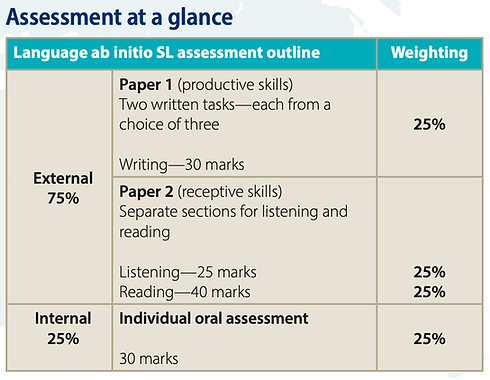
Paper 1 (Productive Skills): A written exam consisting of two short writing tasks, where students choose from three prompts to produce texts like emails, blogs, or letters.
-
Paper 2 (Receptive Skills): A comprehension exam split into two parts: a listening comprehension section based on audio recordings, and a reading comprehension section based on written texts.
-
Individual Oral (Interactive Skills): An internal assessment where students present a brief description of a visual stimulus (a photo linked to a course theme) and engage in a follow-up conversation with their teacher.


Group 3: Individuals and Societies
Economics
What key skills will we develop?
-
Analysis of Economic news
-
Evaluating Government Policies
-
Using Economic diagrams to model real world events
What sort of topics will be covered?
-
Micro Economics
-
Macroeconomics Global Trade
-
Development Economics
Types of assessments:
-
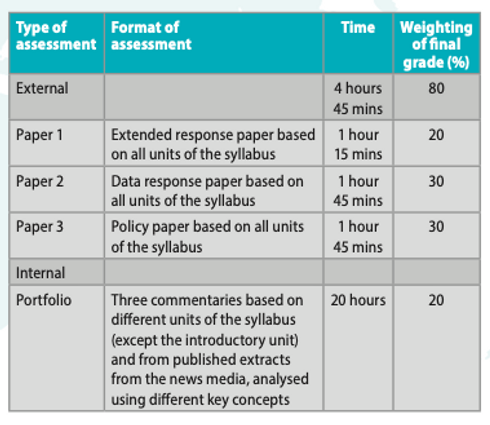
Essay Questions
-
Data analysis
-
News Commentary
Assessment at a glance: SL

Assessment at a glance: HL

Group 3: Individuals and Societies
History
What key skills will we develop?
-
Source reliability analysis
-
Argumentative writing
What sort of topics will be covered?
-
20th century world history
-
Wars and humanitarianism
-
Politics, power and diplomacy
-
Popular movements
Types of assessments:
-
Data-Based Questions
-
Essay Questions
-
Research paper


Group 3: Individuals and Societies
Psychology
What key skills will we develop?
-
Critical analysis of psychological theories and studies
-
Research skills: designing ethical investigations, collecting and interpreting evidence
-
Applying psychological knowledge to real-life issues
What sort of topics will be covered?
-
Research methodology
-
Health and well-being
-
Human development
-
Human relationships
-
Learning and cognition
-
The role of technology, motivation and culture in human behaviour
Types of assessments:
-
Short-answer and extended-response questions
-
Application of psychological knowledge to unfamiliar real-world scenarios
-
Evaluation of unseen research studies


Group 3: Individuals and Societies / Group 4: Sciences
Environmental Systems and Societies (ESS)
What key skills will we develop?
-
Systems Thinking: You learn to model complex environmental issues holistically by mapping out storages, flows, and feedback loops within ecological and human systems.
-
Interdisciplinary Analysis: You build the ability to bridge the natural sciences and humanities, combining data with cultural, economic, and political contexts.
-
Critical Evaluation: You develop the skill to assess different perspectives and judge sustainability solutions from local to global scales.
What sort of topics will be covered?
-
Ecosystems, Biodiversity and Concservation
-
Concepts of Sustainability and Systems Approach
-
The Development of Human Society and Resource Exploitation
-
Application of concepts towards Waters, Land and Atmosphere
Types of assessments:
-
Data Based Questions
-
Case Study Analysis
-
Essay Questions
-
Individual Investigations into a relevant environmental issue.


Group 4: Sciences
Physics
What key skills will we develop?
-
Understanding of models, theories and laws
-
Solving problems and explaining observations
-
Lab skills and data analysis
What sort of topics will be covered?
-
Force and motion
-
Thermal physics
-
Current and circuits
Types of assessments:
-
Lab skills and reporting
-
Problem solving assignments
-
STSE (Science, Technology, Society, and Environment) questions


Group 4: Sciences
Chemistry
What key skills will we develop?
-
Experimental Design & Scientific Inquiry
-
Quantitative Reasoning & Data Analysis
-
Critical Evaluation & Problem Solving
What sort of topics will be covered?
-
Stoichiometric relationships
-
Atomic Structure
-
Bonding and Structure
-
Energetics
-
Chemical Kinetics
-
Equilibrium
-
Acids and Bases
Types of assessments:
-
Lab reports
-
Pop quizzes
-
Presentation (research based)
-
Internal assessment


Group 4: Sciences
Biology
What key skills will we develop?
-
Critical thinking and analysis
-
Designing and evaluating scientific investigations
-
Mathematical calculations and graphical data processing
What sort of topics will be covered?
-
Evolutionary unity and diversity
-
Anatomical form and function
-
Interdependent system interactions
Types of assessments:
-
Multiple-choice and data-based questions
-
Extended-response questions
-
Scientific investigation


Group 5: Mathematics
Mathematics: Analysis and
Approaches (MAA)
What key skills will we develop?
-
Analytical and abstract reasoning: Developing rigorous mathematical arguments, formal algebraic manipulation, and logical deductions/proofs.
-
Problem-solving with and without technology: Analyzing abstract and real-world mathematical concepts both analytically (by hand) and computationally.
-
Mathematical inquiry and communication: Formulating mathematical hypotheses, linking interconnected concepts across topics, and clearly justifying solutions using precise notation.
What sort of topics will be covered?
-
Number and Algebra: Sequences and series, logarithms, binomial theorem, complex numbers (HL), and proof techniques (induction, contradiction).
-
Functions: Polynomial, rational, exponential, logarithmic, and trigonometric functions; transformations and composite/inverse functions.
-
Geometry and Trigonometry: Circular functions, trigonometric identities/equations, and vectors in 2D and 3D (HL).
-
Statistics and Probability: Descriptive statistics, bivariate linear regression, probability rules, and discrete/continuous distributions (e.g., normal, binomial, Poisson for HL).
-
Calculus: Differential and integral calculus, kinematics, optimization, and differential equations (HL).
Types of assessments:
-
Quizzes: Short response questions (with or without GDC)
-
Tests: Routine and Non-routine multi-part questions crossing topics (with or without GDC)
-
Exam: Paper 1 (Non-GDC): Short an extended-response, Paper 2 (GDC): Short and extended-response, Paper 3 HL only (GDC): Multi-part problem-solving investigation questions
-
Mathematical Exploration: An individual piece of written work investigating a chosen area of mathematics of personal interest.


Group 5: Mathematics
Mathematics: Applications and Interpretation (MAI)
What key skills will we develop?
-
Mathematical modelling: Translating practical, real-world scenarios into mathematical models, formulating hypotheses, and testing assumptions.
-
Data analysis and statistical thinking: Collecting, analyzing, and interpreting complex datasets to draw sound statistical inferences.
-
Technology fluency: Leveraging graphic display calculators (GDC), spreadsheets, and mathematical software as central tools for problem-solving.
What sort of topics will be covered?
-
Number and Algebra: Sequences and series, financial mathematics (amortization, annuities), systems of linear equations
-
Functions: Modeling real-world phenomena using linear, quadratic, exponential, and sinusoidal models - Geometry and Trigonometry: 3D spatial geometry and Voronoi diagrams
-
Statistics and Probability: Sampling techniques, linear correlation and rank test, t-tests, chi-square tests
-
Calculus: Introduction to differential calculus, optimization, and numerical integration
Types of assessments:
-
GDC is permitted on all formatives and summatives
-
Quizzes: Short response questions
-
Tests: Routine and Non-routine multi-part questions
-
Exams: Paper 1 Short questions, Paper 2 Multi-part extended-responses questions
-
Mathematical Exploration: An individual piece of written work investigating a chosen area of mathematics of personal interest.


Group 6: The Arts
Visual Arts
What key skills will we develop?
-
Technique & Experimentation: Mastering diverse media (2D, 3D, digital) through hands-on practice
-
Inquiry & Research: Analyzing artistic contexts, intentions, and connections across global culture
-
Reflective Documentation: Documenting creative growth, decision-making, and critical thinking visually and in writing
What sort of topics will be covered?
-
Visual Arts in Context: Investigating how socio-cultural, historical, and personal factors shape art.
-
Visual Arts Methods: Exploring materials, artistic strategies, and problem-solving through art-making.
-
Communicating & Curating: Developing personal artistic intentions and presenting cohesive, meaningful visual works.
Types of assessments:
-
Written and visual documentation of research, media experimentation, and artistic development.
-
Critical investigation linking personal artwork to established artists and cultural contexts.
-
Final Artworks: A selection of completed studio works curated with an artist statement.


Group 6: The Arts
Film
What key skills will we develop?
-
Technical Filmmaking: Mastering camera work, lighting, sound design, and post-production editing
-
Textual Analysis: Critically breaking down film language, codes, conventions, and narrative structures
-
Collaborative Production: Working in key crew roles to execute creative vision.
What sort of topics will be covered?
-
Reading & Contextualizing Film: Exploring global film history, diverse cinema movements, and socio-cultural contexts
-
Filmmaking Roles & Practices: Studying specialized production roles and technical workflow pipelines
-
Collaborative & Independent Projects: Pitching, writing, filming, and editing original narrative short films.
Types of assessments:
-
Written or recorded analysis of film extracts and techniques
-
Multimedia research comparing style and context across films
-
Production Portfolio with process documentation.


Core
Theory of Knowledge (TOK)
What key skills will we develop?
-
Formulating and Analyzing Knowledge Questions
-
Evaluating Perspectives
-
Substantiating with Real-World Evidence
What sort of topics will be covered?
-
Themes: Knowledge and the Knower, Language and Technology
-
Areas of Knowledge: Arts, History, Human Sciences, Natural Sciences and Maths
Types of assessments:
-
Exhibition: 1 Prompt, 3 objects, 950 Words
-
Essays: 1 Prescribed Title, 1600 Words


CAS portfolio considered completed if:
-
Experiences have been ongoing for 18 months, as shown by regular uploads of evidence and reflections to Managebac
-
All 7 learning outcomes addressed
-
All 3 strands of C, A and S addressed
-
CAS Project completed
-
CAS demonstration (core exhibition) completed